
Explore Millennium Ecosystem


Voice AI in Manufacturing: How AI-Powered Defect Logging is Transforming Smart Manufacturing and Industry 4.0
Voice AI in Manufacturing: How AI-Powered Defect Logging is Transforming Smart Manufacturing and Industry 4.0

Bramha Nimbalkar
Graduate engineer trainee, AI innovation
- 16 June 2026
- 8 min read
Voice AI in Manufacturing: How AI-Powered Defect Logging is Transforming Smart Manufacturing and Industry 4.0
Voice AI in Manufacturing: How AI-Powered Defect Logging is Transforming Smart Manufacturing and Industry 4.0
Bramha Nimbalkar
Graduate engineer trainee, AI innovation
- 16 June 2026
- 8 min read
Voice AI in Manufacturing enables frontline workers to report defects and operational observations using natural speech instead of manual forms or terminals. By combining Automatic Speech Recognition (ASR), Natural Language Understanding (NLU), Edge AI Manufacturing, and ERP integration, manufacturers can achieve Real-Time Defect Logging, improved AI Quality Management, and faster decision-making.
Key Takeways
- Voice AI in Manufacturing eliminates manual defect reporting bottlenecks by allowing frontline operators to capture quality issues using natural speech, reducing downtime and improving production efficiency.
- Real-Time Defect Logging accelerates quality management workflows by converting spoken observations into structured, actionable data that can be analyzed and acted upon instantly.
- Edge AI and Natural Language Processing improve factory-floor intelligence by understanding manufacturing terminology, classifying defects automatically, and integrating directly with ERP and quality systems.
- Smart Manufacturing initiatives succeed when technology adapts to workers, enabling hands-free, frictionless reporting that drives higher adoption and better data accuracy.
- AI-Powered Quality Management delivers measurable operational impact, reducing defect logging time from seconds to milliseconds while improving traceability and root-cause analysis.
- Industrial AI Solutions create long-term scalability beyond a single use case, providing a foundation for predictive quality, yield optimization, computer vision inspection, and Industry 4.0 transformation.
- The future of Industry 4.0 lies in capturing frontline expertise as data, transforming human observations into structured intelligence that improves decision-making across the manufacturing value chain.
When a Refrigerator Assembly Line Started Talking Back
A worker notices a misaligned panel moving down a refrigerator assembly line. Another spots a loose connector. A third identifies a faulty capacitor. None of these observations are unusual. What happens next, however, determines whether the defect becomes actionable insight or simply another missed opportunity.
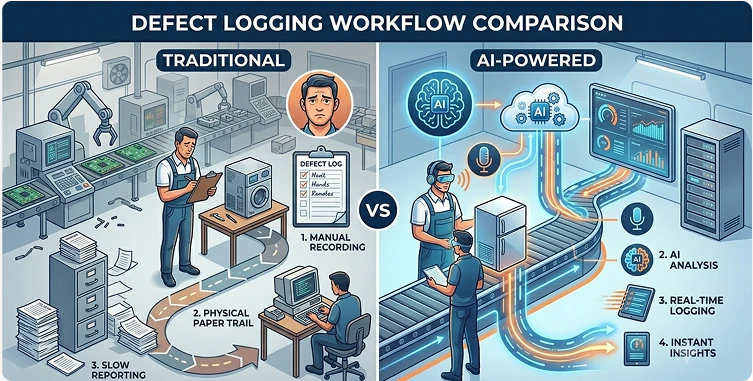
For decades, manufacturing facilities have relied on manual defect logging. Workers pause their tasks, walk to a terminal, enter a fault code, and return to production. Each interruption seems insignificant. Yet when repeated hundreds of times across shifts, these moments accumulate into a hidden operational cost.
This was the reality at a leading electronics manufacturer’s refrigerator production line. The facility generated substantial production data every day. The problem was not the absence of information. The challenge was the delay between observing a defect and capturing it in a format that could drive immediate action.
As manufacturers increasingly embrace Smart Manufacturing and Industry 4.0, this challenge is becoming more visible. Organizations are investing heavily in Manufacturing Automation, Industrial AI Solutions, and AI-Powered Quality Inspection systems. Yet many quality processes remain dependent on manual inputs. Millennium Techlink was engaged to address this gap and explore whether Voice AI in Manufacturing could remove friction from the quality reporting process.
Industry Context: Why This Matters Now
The manufacturing sector is undergoing rapid transformation. Across global markets, organizations are accelerating investments in Industry 4.0 technologies to improve productivity, quality consistency, and supply-chain competitiveness. Industry analysts estimate that spending on digital manufacturing technologies continues to grow significantly as companies pursue automation and operational intelligence.
In India, digital transformation is becoming a competitive necessity. Manufacturers face increasing pressure to meet stringent quality requirements, improve traceability, and maintain global competitiveness. Smart Manufacturing initiatives are moving beyond experimentation and becoming strategic priorities.
The challenge is not merely collecting more data. Modern manufacturing environments already generate enormous volumes of information. The real opportunity lies in capturing high-quality, structured data at the exact moment observations occur. This is where Voice AI in Manufacturing presents a compelling advantage.
INDUSTRY SNAPSHOT
- Global Lighthouse factories identified by the World Economic Forum have reported major improvements in productivity, quality, and sustainability through Industry 4.0 adoption.
- Advanced manufacturing technologies can unlock significant productivity improvements across industrial operations (McKinsey).
- Manufacturing contributes approximately 16–17% of India’s GDP (IBEF).
- Adoption of AI, IoT, and digital manufacturing initiatives continues to accelerate across Indian industry (NASSCOM).
The Hidden Cost of Manual Defect Logging
Manual defect logging introduces three major challenges. First, productivity suffers when workers must stop performing value-added activities to enter data. Second, delays between defect occurrence and reporting create data latency that complicates root-cause analysis. Third, time pressure and inconsistent terminology often reduce data quality.
The organization had already evaluated barcode scanners and touchscreen interfaces. While these approaches improved accuracy, they still required workers to interrupt their workflow. The fundamental problem remained unchanged.
The team reframed the challenge with a simple question:

“How do we make defect logging invisible?”
Reimagining Defect Logging Through Voice AI
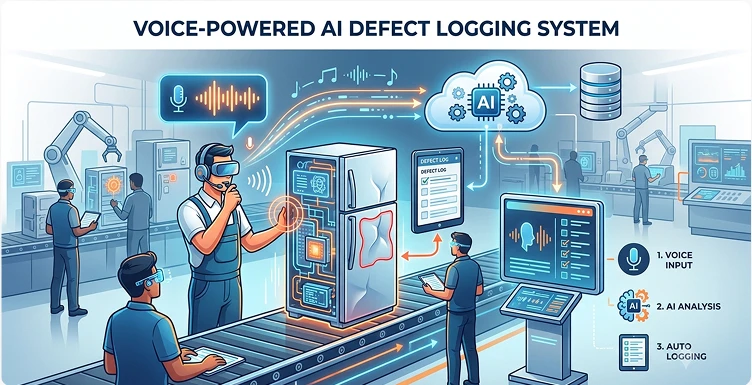
Millennium Techlink designed a voice-powered defect logging system that allows workers to report issues naturally while continuing their primary task. The objective was straightforward: enable hands-free and eyes-free defect reporting without disrupting production flow.
The system listens, understands, classifies, and records observations in real time. Workers simply describe what they see. The AI handles the complexity behind the scenes.
This approach transformed defect reporting from a separate activity into a natural extension of the manufacturing process. Instead of adapting people to technology, the technology adapted to the way people already worked.
Inside the Architecture
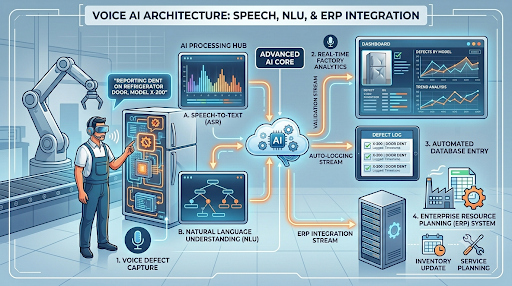
The solution was built around three integrated layers.
Layer 1: Voice Capture and Pre-Processing
Industrial-grade microphones captured spoken observations directly at the workstation. Advanced noise suppression filtered compressor hum, conveyor noise, fan sounds, and cross-talk.
Layer 2: Domain-Tuned Speech Recognition and NLU
A specialized Automatic Speech Recognition model was fine-tuned using manufacturing terminology, defect descriptions, and local speech patterns. The Natural Language Understanding layer extracted structured information such as defect type, component, severity, and workstation ID.
Layer 3: Real-Time Classification and ERP Integration
Captured observations were automatically mapped to defect taxonomies, assigned severity levels, and integrated into quality management systems. Supervisors received immediate visibility through live dashboards.
What the Factory Floor Taught Us
Every industrial AI deployment reveals lessons that extend beyond technology.
One of the most significant discoveries was the variability of the acoustic environment. Noise conditions changed throughout the day and differed across stations. Static noise models were insufficient, requiring adaptive noise estimation.
Worker adoption exceeded expectations. The team anticipated extensive change management efforts. Instead, workers embraced the system because it reduced effort and simplified reporting.
Perhaps the most valuable lesson involved language. Official defect codebooks did not fully reflect how workers described issues in practice. Informal shorthand and real-world terminology played a crucial role. The deployment demonstrated that successful Industrial AI Solutions must learn from people, not just process documentation.
Key Learnings for Industrial AI Deployments
The project reinforced several principles that now guide future initiatives.
Edge AI Manufacturing is essential for latency-sensitive applications. Cloud-only processing introduces delays and dependency on network availability.
Structured output creates more value than transcription alone. The objective is not merely converting speech into text. The goal is transforming observations into clean, searchable, actionable information.
Human factors matter. Microphone placement, feedback mechanisms, and fallback workflows significantly influence user trust and adoption.
Finally, successful deployments become reusable assets. The architecture, integration patterns, and deployment methodology developed during this project can now support future implementations.
The Impact
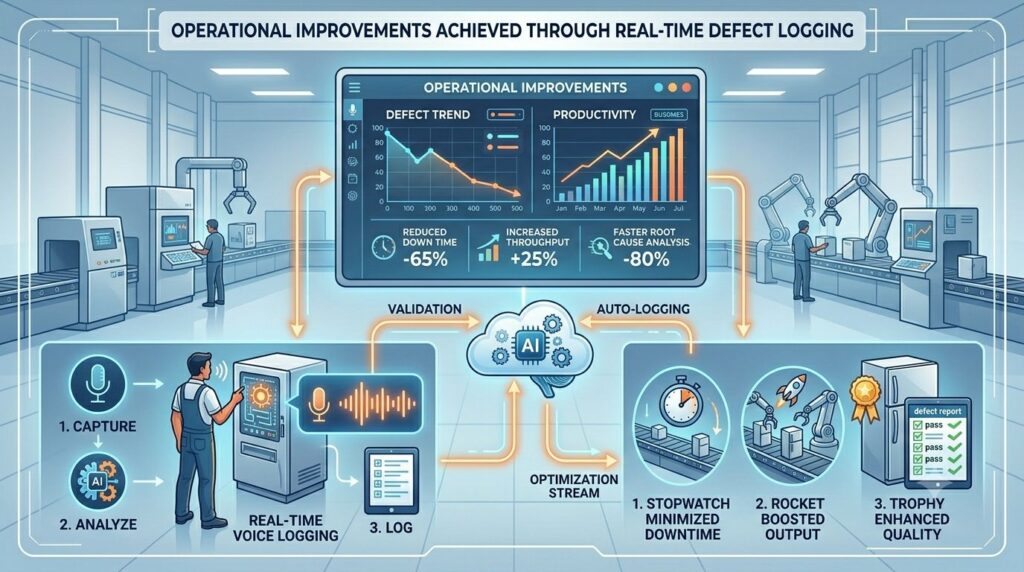
Following deployment, measurable improvements were observed across the production line.
Logging time per defect event decreased from approximately thirty seconds to under three seconds. Structured data completeness improved significantly. Workers remained focused on production tasks without walking to terminals. Defect records entered quality systems within seconds rather than minutes. Supervisors gained real-time visibility through live dashboards.
Beyond operational efficiency, improved data quality strengthened defect analysis and supported more reliable process improvement initiatives.
Why This Matters Beyond One Factory
The challenge addressed in this deployment is not unique to a single facility. Similar conditions exist across electronics manufacturing, automotive production, pharmaceuticals, food processing, and textiles.
Workers often perform hands-on tasks while simultaneously serving as critical sources of operational insight. Capturing those insights efficiently remains a persistent challenge.
As Industry 4.0 adoption becomes mainstream across Indian manufacturing, organizations will increasingly seek technologies that bridge the gap between observation and action. Voice AI in Manufacturing represents one example of how AI Quality Management and Manufacturing Automation can deliver measurable business value without disrupting existing workflows.
The Future of AI on the Factory Floor
This deployment is informing a broader roadmap for industrial innovation. Voice-based defect logging is evolving into a configurable offering capable of supporting multiple manufacturing environments.
At the same time, initiatives involving Computer Vision Inspection, Yield Optimization, AI-Powered Quality Inspection, and AI-Assisted Quality Management are advancing in parallel.
These efforts share a common philosophy. The greatest value of Industrial AI Solutions is not replacing human judgment. It is removing barriers that prevent human expertise from becoming structured, actionable intelligence.
“The most valuable industrial AI systems don’t replace human judgment. They remove the friction that prevents human expertise from becoming actionable data.”
Closing Thought
Factories generate extraordinary volumes of knowledge every day. Much of it exists in the observations of frontline workers who identify problems before systems detect them.
The future of Smart Manufacturing will not be defined solely by faster machines or more sophisticated automation. It will be shaped by technologies that capture knowledge at the moment it is created.
The factory floor already knows what is wrong.
The opportunity lies in making sure the data gets heard.
Frequently Asked Questions (FAQs)
1. What is Voice AI in Manufacturing and how does it work?
Factories generate extraordinary volumes of knowledge every day. Much of it exists in the observations of frontline workers who identify problems before systems detect them.
The future of Smart Manufacturing will not be defined solely by faster machines or more sophisticated automation. It will be shaped by technologies that capture knowledge at the moment it is created.
The factory floor already knows what is wrong.
The opportunity lies in making sure the data gets heard.
2. How does Voice AI improve quality management in smart manufacturing environments?
Voice AI improves AI-Powered Quality Management by enabling Real-Time Defect Logging, reducing reporting delays, and increasing data accuracy. Manufacturers gain immediate visibility into production issues, allowing quality teams to respond faster, improve traceability, and perform more effective root-cause analysis.
3. Why is Real-Time Defect Logging important for Industry 4.0?
Industry 4.0 relies on accurate, timely, and connected data to drive operational decisions. Real-Time Defect Logging ensures that production issues are captured at the moment they occur, reducing data latency and enabling faster corrective actions. This helps manufacturers improve productivity, reduce waste, and strengthen overall process efficiency.
4. What role does Edge AI play in Voice AI Manufacturing solutions?
Edge AI Manufacturing processes voice data locally on or near the production floor, minimizing latency and reducing dependence on cloud connectivity. This enables faster response times, improved reliability, enhanced data security, and uninterrupted operation in demanding industrial environments where real-time performance is critical.
5. Can Voice AI be used beyond defect reporting in manufacturing?
Yes. While Voice AI is highly effective for defect logging and quality management, the same Industrial AI framework can support maintenance reporting, safety observations, production tracking, compliance documentation, operator assistance, and workflow automation. As Smart Manufacturing adoption grows, Voice AI is expected to become a key enabler of broader digital transformation initiatives across factories.

About the author:
bramha nimbalkar
Graduate engineering trainee, AI-Innovation
Bramha Nimbalkar is a Graduate Engineer Trainee – AI Innovation at Millennium TechLink, where he contributes to the development of AI-powered solutions that bridge the gap between technology and business outcomes. His interests span Artificial Intelligence, Smart Manufacturing, Industry 4.0, and Industrial Automation, with a focus on creating practical innovations that enhance efficiency, quality, and decision-making in modern enterprises.
table of contents
- Key Takeways
- When a Refrigerator Assembly Line Started Talking Back
- Industry Context: Why This Matters Now
- INDUSTRY SNAPSHOT
- The Hidden Cost of Manual Defect Logging
- Reimagining Defect Logging Through Voice AI
- Inside the Architecture
- What the Factory Floor Taught Us
- Key Learnings for Industrial AI Deployments
- The Impact
- Why This Matters Beyond One Factory
- The Future of AI on the Factory Floor
- Closing Thought
- Frequently Asked Questions (FAQs)