
Explore Millennium Ecosystem


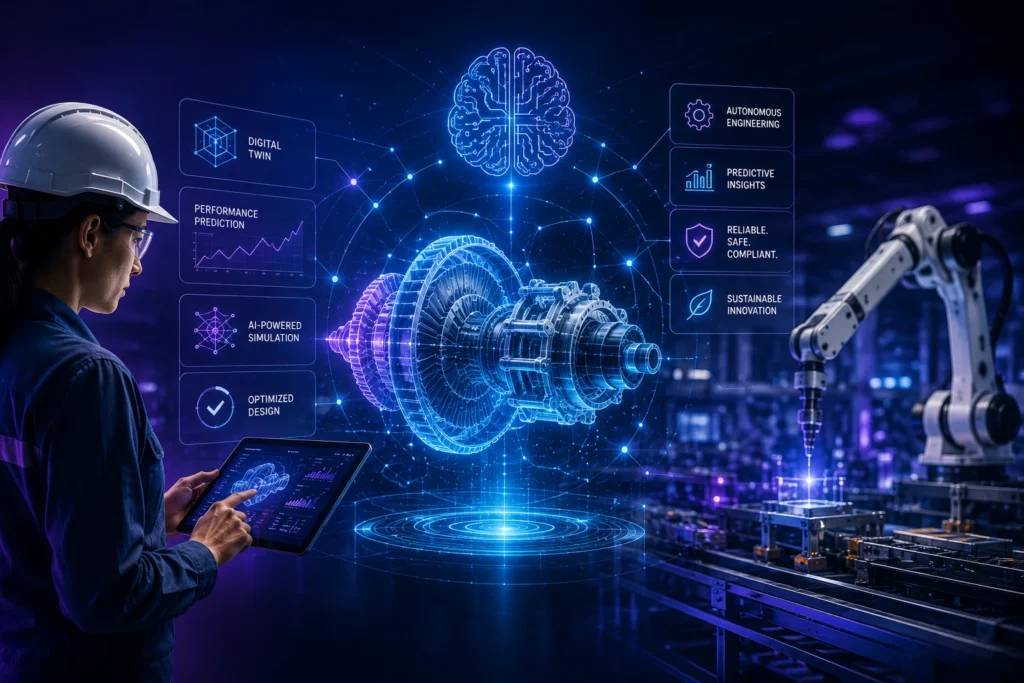
Beyond ChatGPT: How AI, Digital Twins & Autonomous Engineering Are Redefining Industrial Innovation

Tanishka Pitale
AI innovation
- 7 July 2026
- 10 min read
Beyond ChatGPT: How AI, Digital Twins & Autonomous Engineering Are Redefining Industrial Innovation
Tanishka Pitale
AI innovation
- 7 July 2026
- 10 min read
Key Takeways
- AI is evolving from automation to intelligent engineering decision-making.
- Digital Twins bridge physical and virtual systems for predictive insights.
- AI-powered simulation accelerates product development while reducing costs and engineering risk.
- High-quality engineering data is the foundation of successful AI adoption.
- Explainable AI is essential for building trust in safety-critical engineering applications.
- Autonomous Engineering will empower engineers to innovate faster—not replace them.
Introduction
Not long ago, Artificial Intelligence was primarily associated with chatbots, content generation, and virtual assistants. Today, its impact extends far beyond conversational applications. Across engineering, manufacturing, and product development, AI is redefining how organizations design, validate, and optimize products throughout their lifecycle.
From AI-powered Digital Twins and intelligent engineering simulation to autonomous design optimization, a new era of innovation is emerging—one where data is no longer just collected, but transformed into actionable intelligence. This shift is enabling organizations to predict failures before they occur, reduce development cycles, improve product quality, and make faster, more informed engineering decisions.
As industries embrace the next phase of Industry 4.0, the question is no longer whether AI will transform engineering—it’s how quickly organizations can harness its full potential.
In this article, we explore how Artificial Intelligence, Digital Twins, and Autonomous Engineering are reshaping industrial innovation, the technologies driving this transformation, and what engineering leaders need to know to stay ahead in an increasingly intelligent future.
Artificial Intelligence Has Left the Chat Window
Artificial Intelligence has become one of the most talked-about technologies of the decade.
From generating content and writing code to answering complex questions, AI has transformed how individuals work and collaborate. Yet these consumer-facing applications represent only a fraction of AI’s true potential.
The real transformation is taking place where innovation begins—inside engineering teams, manufacturing facilities, and product development organizations.
Today, Artificial Intelligence is helping engineers predict equipment failures before they occur, optimize complex product designs, automate engineering analysis, and simulate real-world performance long before a physical prototype exists.
This evolution is fundamentally changing how products are designed, validated, manufactured, and continuously improved.
As organizations accelerate their Industry 4.0 initiatives, AI is no longer viewed as another digital tool.
It is becoming the intelligence layer connecting engineering knowledge, operational data, and business decisions.
The organizations that successfully integrate AI into their engineering ecosystem will be better positioned to innovate faster, reduce development costs, improve product quality, and respond more effectively to changing market demands.
The future of engineering won’t belong to organizations that collect the most data. It will belong to those that transform data into intelligent decisions.

The future of engineering won't belong to organizations that collect the most data. It will belong to those that transform data into intelligent decisions.
Industry Snapshot
Artificial Intelligence is rapidly becoming a strategic priority across engineering and manufacturing.
Recent industry reports indicate that organizations are increasingly investing in AI-powered engineering, Digital Twins, predictive analytics, and intelligent automation to improve productivity, accelerate innovation, and strengthen operational resilience.
Some key industry trends include:
- AI is becoming a core enabler of Industry 4.0 initiatives across manufacturing and industrial engineering.
- Digital Twins are increasingly being adopted to optimize product development, predictive maintenance, and factory operations.
- Engineering simulation powered by AI is helping organizations reduce physical prototypes and accelerate product validation.
- Explainable AI and trustworthy AI are emerging as critical priorities for regulated and safety-critical industries.
- Engineering organizations are shifting from reactive decision-making toward predictive and autonomous operations.
These trends highlight a broader shift—from digital transformation to intelligent transformation, where AI augments human expertise rather than replacing it.
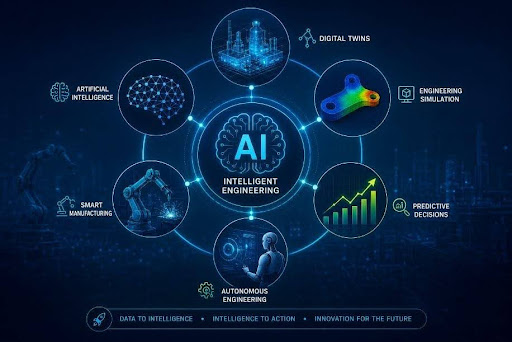
Why Engineering Needs More Than Automation
For decades, organizations focused on automating repetitive processes to improve efficiency.
Manufacturing lines became increasingly connected.
Enterprise software streamlined operations.
Engineering simulation accelerated product validation.
While these technologies delivered measurable improvements, they largely depended on predefined rules and human intervention.
Today’s Artificial Intelligence represents a much more significant shift.
Instead of simply executing programmed instructions, AI can recognize patterns, predict outcomes, recommend optimal solutions, and continuously learn from operational data.
Rather than replacing engineers, AI enhances their ability to make faster and more informed decisions.
Consider a production environment where thousands of sensors continuously monitor equipment performance.
Traditional systems generate alerts only after predefined thresholds are exceeded.
An AI-powered system, however, analyzes historical trends, environmental conditions, maintenance history, and operational behavior to predict failures before they happen.
Similarly, AI-enabled engineering platforms can evaluate thousands of design alternatives simultaneously—optimizing performance, manufacturability, cost, sustainability, and reliability in a fraction of the time required by conventional methods.
This shift allows organizations to reduce engineering iterations, shorten development cycles, and accelerate innovation without compromising quality.
The Rise of Decision-Centric Enterprises
Modern engineering organizations generate enormous volumes of information.
CAD models.
Simulation results.
IoT sensor data.
Quality reports.
Manufacturing records.
Customer feedback.
Supply chain information.
Individually, each dataset provides valuable insights.
Together, they represent an untapped opportunity to transform engineering decision-making.
Artificial Intelligence enables organizations to connect these previously isolated data sources and generate contextual intelligence that supports faster, more informed decisions.
Instead of reacting to failures, organizations can anticipate them.
Instead of relying solely on historical experience, engineers can evaluate predictive insights supported by data.
Instead of manually exploring design alternatives, AI can rapidly identify the most effective solutions.
Leading organizations are already applying AI to:
- Predict equipment failures before production is affected.
- Improve product quality through intelligent defect detection.
- Optimize manufacturing performance using predictive analytics.
- Accelerate engineering design through AI-assisted optimization.
- Reduce product development timelines by minimizing validation cycles.
This evolution marks the transition from data-driven enterprises to decision-centric enterprises, where AI continuously supports engineering teams with actionable insights.
The result is not fewer engineers.
It is better-equipped engineers capable of solving increasingly complex challenges with greater confidence.
Artificial Intelligence doesn't replace engineering expertise—it amplifies it.
Digital Twins: Where Physical and Digital Worlds Converge
One of the most transformative technologies enabling intelligent engineering is the Digital Twin.
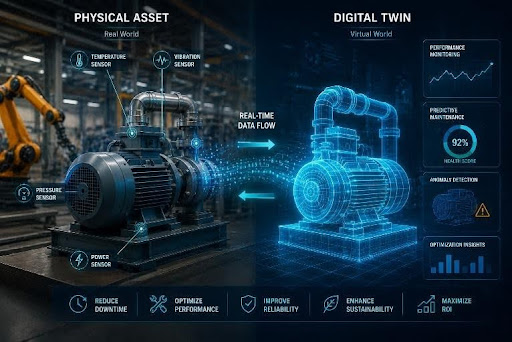
Unlike traditional 3D models, a Digital Twin is a living virtual representation of a physical product, machine, production line, or entire manufacturing facility.
It continuously synchronizes with real-world operational data, creating a dynamic environment where organizations can monitor performance, predict failures, optimize operations, and simulate future scenarios.
When Artificial Intelligence is integrated with Digital Twins, engineering teams gain unprecedented visibility into how products and systems behave throughout their lifecycle.
This enables organizations to:
- Predict maintenance requirements before failures occur.
- Validate engineering designs virtually.
- Optimize manufacturing performance in real time.
- Reduce downtime and operational risk.
- Improve sustainability through energy optimization.
Rather than relying solely on historical performance, Digital Twins allow engineers to explore future possibilities before making critical decisions.
This predictive capability is becoming a defining characteristic of next-generation engineering organizations.
Engineering Simulation: Turning Possibilities into Predictable Outcomes
Every engineering decision carries a degree of uncertainty.
Will the design perform as expected under real-world conditions? Can it withstand extreme temperatures, vibrations, or prolonged operational stress? Will a small design modification improve efficiency—or introduce new risks?
Traditionally, answering these questions required multiple physical prototypes, extensive testing, and significant development time.
Today, Artificial Intelligence is fundamentally changing that process.
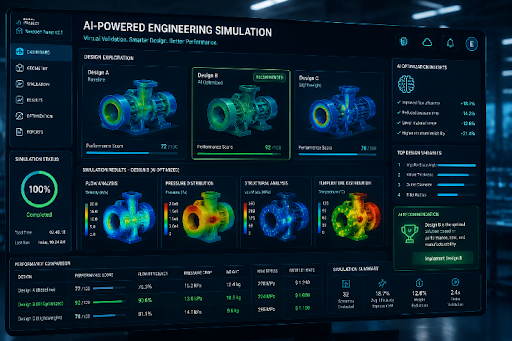
By combining engineering simulation with AI-driven analytics, organizations can evaluate thousands of design scenarios before manufacturing even begins. Engineers can virtually test product performance, identify potential failure points, and optimize designs with remarkable speed and accuracy.
This shift is enabling businesses to move beyond trial-and-error engineering toward predictive, data-driven product development.
Some of the most impactful applications include:
- Virtual Product Validation before physical prototyping
- Design Optimization based on performance, cost, and manufacturability
- Failure Prediction under varying operating conditions
- Thermal, Structural, and Fluid Simulations enhanced through AI
- Reduced Product Development Cycles and faster time-to-market
Instead of asking “Will this design work?”, engineering teams can now ask “Which design performs best?”
That distinction is redefining modern product development.
Simulation is no longer just a validation tool—it has become a strategic advantage for faster, smarter engineering.
Data Is the Foundation of Every Intelligent Decision
Artificial Intelligence often receives the spotlight, but behind every successful AI initiative lies something far less glamorous—high-quality data.
Engineering organizations generate enormous amounts of information throughout the product lifecycle. CAD models, simulation outputs, sensor data, quality reports, manufacturing records, and field performance data all contribute valuable insights.
However, when this information exists in disconnected systems or inconsistent formats, even the most advanced AI models struggle to deliver meaningful results.
Successful AI adoption depends on building a trusted digital foundation.
This includes:
- Standardized engineering data
- Strong data governance
- Connected PLM, MES, ERP, and IoT ecosystems
- Reliable data validation processes
- Secure and scalable digital infrastructure
Organizations that prioritize data quality are better equipped to generate accurate predictions, automate engineering workflows, and build AI systems that engineers can confidently trust.
The lesson is simple:
AI doesn’t create value from data—it amplifies the value of well-managed data.
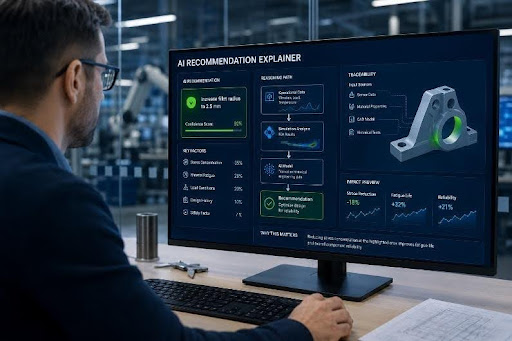
Why Explainable AI Matters More Than Ever
As Artificial Intelligence becomes increasingly involved in engineering decisions, transparency is becoming just as important as intelligence.
Imagine an AI system recommending a design change for a critical aerospace component or identifying a potential defect in a medical device.
Would engineers be comfortable accepting the recommendation without understanding the reasoning behind it?
Probably not.
This is why Explainable AI (XAI) is becoming a strategic priority.
Rather than functioning as a “black box,” Explainable AI provides visibility into the factors that influenced a prediction or recommendation.
For engineering teams, this creates several important advantages:
- Greater confidence in AI-assisted decisions
- Easier compliance with regulatory requirements
- Faster root-cause analysis
- Improved collaboration between engineers and AI systems
- Stronger trust across cross-functional teams
Ultimately, the future of engineering AI isn’t about replacing human judgment.
It’s about enabling engineers to make better-informed decisions backed by transparent, data-driven intelligence.
Trust is built when AI doesn't just provide answers—but explains them.
AI in Safety-Critical Engineering: Innovation Without Compromise
Industries such as aerospace, automotive, healthcare, semiconductor manufacturing, industrial automation, and rail transportation operate under exceptionally high standards of safety and compliance.
In these environments, every engineering decision carries significant responsibility.
Artificial Intelligence has tremendous potential to accelerate innovation—but only when supported by rigorous engineering validation.
Leading organizations are integrating AI alongside established engineering practices such as:
- Model-Based Systems Engineering (MBSE)
- Requirements-Based Verification & Validation
- Functional Safety Engineering
- Digital Verification Platforms
- Simulation-Driven Development
Rather than replacing proven engineering methodologies, AI enhances them by accelerating analysis, identifying hidden risks, and supporting evidence-based decision-making.
This balanced approach allows organizations to innovate confidently while maintaining the quality, reliability, and regulatory compliance demanded by safety-critical industries.
As AI adoption continues to grow, organizations that combine intelligent automation with engineering discipline will be best positioned to deliver safer, more reliable, and higher-performing products.
Looking Ahead: The Rise of Autonomous Engineering
The next evolution of Artificial Intelligence extends beyond assisting engineers—it is enabling systems to actively participate in engineering workflows.
This emerging paradigm is known as Autonomous Engineering.
Instead of manually evaluating a limited number of design alternatives, engineers can define objectives, constraints, and performance targets while AI explores thousands of optimized possibilities.
Generative design, AI-assisted simulation, Digital Twins, and intelligent optimization are converging to create engineering environments that continuously learn, adapt, and improve.
Importantly, Autonomous Engineering does not replace human creativity.
Instead, it allows engineers to focus on innovation, systems thinking, and solving complex challenges while AI accelerates analysis and repetitive decision-making.
The future of engineering will not belong to humans alone—or AI alone.
It will belong to organizations that combine the strengths of both.
As Industry 4.0 continues to evolve, engineering excellence will increasingly depend on the ability to transform data into intelligence, intelligence into action, and action into continuous innovation.
Conclusion
Artificial Intelligence is no longer an emerging technology—it is becoming the foundation of next-generation engineering and industrial innovation. As AI converges with Digital Twins, engineering simulation, and Autonomous Engineering, organizations have an opportunity to move beyond automation and embrace predictive, data-driven decision-making.
The future belongs to businesses that combine human expertise with intelligent technologies to design smarter products, accelerate innovation, and build more resilient engineering ecosystems. Those who invest in this transformation today will be better positioned to lead the next chapter of Industry 4.0.
Frequently Asked Questions (FAQs)
1. What is the role of Artificial Intelligence in modern engineering?
Artificial Intelligence helps engineering teams automate analysis, optimize product designs, predict failures, and make data-driven decisions. By integrating AI with engineering workflows, organizations can improve product quality, reduce development time, and accelerate innovation.
2. How do Digital Twins improve product development?
Digital Twins create real-time virtual representations of physical products or systems. They enable engineers to simulate performance, predict maintenance needs, validate designs, and optimize operations before physical deployment, reducing costs and improving reliability.
3. What is Autonomous Engineering, and how is it different from traditional engineering?
Autonomous Engineering uses AI to assist with engineering tasks such as design optimization, simulation, and decision support. Rather than replacing engineers, it augments their expertise by automating repetitive analysis and identifying optimal engineering solutions faster.
4. Why is Explainable AI important in engineering and manufacturing?
Explainable AI provides transparency into how AI models generate recommendations or predictions. This helps engineering teams validate AI-driven decisions, meet regulatory requirements, improve collaboration, and build trust in safety-critical applications.
5. How are AI, Digital Twins, and Engineering Simulation shaping Industry 4.0?
Together, these technologies enable predictive maintenance, intelligent product development, virtual validation, real-time operational monitoring, and continuous optimization. Their convergence is helping organizations transition from reactive operations to intelligent, data-driven engineering across the product lifecycle.
About the author:
Tanishka Pitale
AI-innovation
Tanishka is a member of the AI Innovation team at Millennium TechLink, where she explores the intersection of Artificial Intelligence, Digital Engineering, Industry 4.0, and emerging industrial technologies. Her work focuses on translating complex technological advancements into practical insights that help engineering and manufacturing organizations accelerate innovation, enhance product development, and prepare for the future of intelligent engineering.
table of contents
- Introduction
- Artificial Intelligence Has Left the Chat Window
- Why Engineering Needs More Than Automation
- The Rise of Decision-Centric Enterprises
- Digital Twins: Bridging the Physical and Digital World
- Engineering Simulation Meets Artificial Intelligence
- Explainable AI
- AI in Safety-Critical Engineering
- Autonomous Engineering
- Conclusion
- FAQs