
Explore Millennium Ecosystem

From Quality Control to Quality Intelligence: Why Modern Organizations Need a Smarter QMS

Vaishnavi Gore
AI innovation
- 24 Sept 2026
- 10 min read
From Quality Control to Quality Intelligence: Why Modern Organizations Need a Smarter QMS
Vaishnavi Gore
AI innovation
- 24 Sept 2026
- 10 min read
Key Takeways
- Quality is a business responsibility, not just a quality-department function.
- A QMS creates consistency by standardizing how critical processes are executed.
- Digital QMS moves quality beyond documentation into connected workflows and real-time visibility.
- Poor quality has a measurable business impact, with 89% of ASQE respondents reporting at least a moderate financial impact in 2025.
- Leadership involvement matters: 87% of ASQE respondents said leadership made quality a priority in 2025.
- ISO 9001:2026 brings quality management into a more future-focused business context, strengthening areas such as leadership, culture and strategic alignment.
- Quality 4.0 connects quality with digital technologies, including analytics, AI and connected data.
- Traceability is becoming increasingly important as products, processes and regulatory requirements become more complex.
- A modern QMS should support decisions, not simply store records.
- The future of quality is proactive: preventing problems, identifying patterns and continuously improving performance.
Quality is no longer something organizations inspect at the end of a process. It is something they need to build into every decision, workflow and outcome.
A product can be innovative.
A process can be efficient.
A company can have talented people.
But when quality depends on individual effort, disconnected spreadsheets, manual approvals and fragmented documentation, consistency becomes difficult to maintain.
That is where a Quality Management System (QMS) becomes more than a compliance requirement.
It becomes the operating framework that connects people, processes, data, risks and continuous improvement.

The future of quality is not about finding more defects. It is about creating systems that make defects harder to create in the first place.
Introduction: Why Quality Has Become a Business Priority
Quality used to be viewed primarily as the responsibility of the quality department.
Today, that approach is increasingly difficult to sustain.
Organizations operate across increasingly complex supply chains, multiple locations, larger teams, stricter regulatory environments and rapidly changing customer expectations. As complexity increases, the cost of inconsistent processes increases with it.
The latest ASQE Insights on Excellence benchmarking highlights the financial impact of poor quality: 89% of respondents reported at least a moderate financial impact from poor quality in 2025, with 37% reporting a high impact. [Source: ASQE, Insights on Excellence 2025]
That makes quality more than an operational metric.
It becomes a business-performance issue.
At the same time, quality is receiving greater attention at the leadership level. ASQE reports that 87% of respondents agreed their organization’s leaders made quality a priority in 2025, up 15 percentage points from 2024. [Source: ASQE, Insights on Excellence 2025]
This is why organizations increasingly need systems that can make quality structured, measurable, traceable and continuously improvable.
When poor quality has a measurable financial impact, quality management stops being a back-office function and becomes a leadership responsibility.
What Is a Quality Management System (QMS)?
A Quality Management System (QMS) is a structured framework of processes, responsibilities, controls and information that enables an organization to consistently deliver products or services that meet defined requirements.
In simple terms:
A QMS defines how an organization manages quality — from planning and execution to measurement, corrective action and continual improvement.
ISO describes ISO 9001 as a globally recognized quality management standard that helps organizations improve performance, meet customer expectations and demonstrate their commitment to quality. Its requirements cover establishing, implementing, maintaining and continually improving a QMS. [Source: ISO 9001:2026]
The important point is that a QMS is not simply a collection of documents.
It connects:
People → Processes → Documentation → Risk → Performance → Improvement
A well-designed QMS helps organizations establish consistency without preventing teams from adapting to changing business requirements.
The seven principles behind quality management
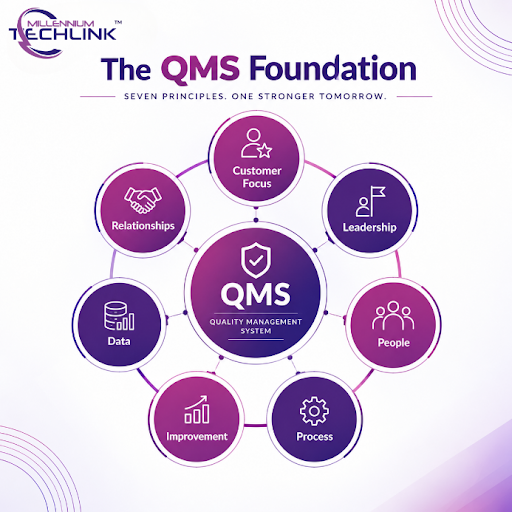
ISO’s quality management framework is built around seven principles:
- Customer focus
- Leadership
- Engagement of people
- Process approach
- Improvement
- Evidence-based decision making
- Relationship management
These principles provide the foundation for building quality into organizational processes rather than treating it as an isolated activity. [Source: ISO Quality Management Principles, ISO 9000 Family]
Why Traditional Quality Management Is No Longer Enough
Many organizations have a QMS on paper.
The bigger question is:
How effectively does that QMS work in day-to-day operations?
A process may technically exist, but execution can still depend on:
- Excel-based tracking
- Email approvals
- Manual document updates
- Multiple versions of the same file
- Paper-based records
- Manually maintained audit trails
- Disconnected corrective-action tracking
- Information stored across different systems
These approaches can work at a smaller scale.
But as an organization grows, complexity grows with it.
A change in one process can affect several departments. A revised document needs to reach multiple users. A corrective action may require input from quality, engineering, production and management.
Without connected workflows, organizations can spend more time managing the quality system than improving quality itself.
This is one reason digital transformation is changing the role of quality management.
From QMS to Digital QMS
A Digital Quality Management System (eQMS or Digital QMS) takes the principles of traditional quality management and connects them through digital workflows, centralized information and automated processes.
ISO notes that a QMS can be delivered digitally rather than through paper checklists and forms, helping organizations save time, reduce risk and minimize the possibility of human error. [Source: ISO]
The shift is therefore not simply:
Paper → Software
It is:
Manual processes → Connected processes
Static records → Live information
Reactive decisions → Data-informed decisions
Periodic review → Continuous visibility
What changes with a Digital QMS?
Traditional QMS | Digital QMS |
|---|---|
Paper-based records | Centralized digital records |
Manual approvals | Automated workflows |
Multiple document versions | Controlled version management |
Periodic reporting | Real-time dashboards |
Manual audit preparation | Traceable audit history |
Reactive corrective action | Structured CAPA workflows |
Information silos | Cross-functional visibility |
Spreadsheet tracking | Centralized data |
This transformation is increasingly aligned with the broader Quality 4.0 movement.
The Business Value of a Modern QMS
A modern QMS should not exist only to help an organization pass an audit.
It should help the organization operate better.
- Consistency across processes
Standardized workflows reduce variation in how different teams execute the same activity.
- Better document control
Teams can work with the correct version of procedures, specifications, policies and records.
- Faster decision-making
When quality information is available in one place, managers can identify trends and act earlier.
- Improved traceability
Digital records create a clearer history of approvals, changes, actions and decisions.
- Stronger risk management
Risks can be identified, assigned, monitored and reviewed instead of being addressed only after an issue occurs.
- More effective corrective action
CAPA processes provide a structured approach to identifying root causes, implementing actions and verifying effectiveness.
- Better audit readiness
Instead of preparing for an audit by collecting information from multiple sources, organizations can maintain traceable records continuously.
- Continuous improvement
A QMS creates the feedback loop required to measure performance, identify gaps and improve processes.
A good QMS does not merely document how work should happen. It creates visibility into how work is actually happening.
The Core Capabilities of a Modern QMS
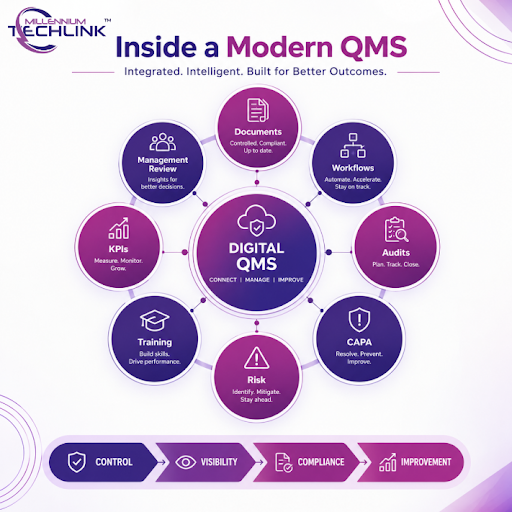
While QMS requirements vary by industry and organization, a modern digital system commonly brings together several interconnected capabilities.
Document & Version Control
Manage policies, procedures, specifications, work instructions and controlled records while maintaining version history.
Workflow Automation
Digitize review, approval, escalation and authorization processes to reduce dependence on email and manual follow-ups.
Audit Management
Plan audits, assign responsibilities, record findings and track actions through closure.
Corrective & Preventive Action — CAPA
Track nonconformities, investigate root causes, assign corrective actions and monitor effectiveness.
Risk & Change Management
Identify risks, assess their impact, manage mitigation actions and control changes across relevant processes.
Training & Competency
Track employee training, qualifications, competencies and required refresher activities.
Performance Monitoring
Use dashboards, KPIs and quality metrics to understand process performance and identify areas for improvement.
Management Review
Bring relevant quality information together to support evidence-based management decisions.
Quality 4.0: The Next Evolution of Quality Management
The next stage of QMS evolution is often described as Quality 4.0.
Quality 4.0 brings quality management closer to the technologies and operating models associated with Industry 4.0 — including connected data, automation, analytics, artificial intelligence and digital workflows.
The objective is not to replace quality professionals with technology.
It is to give quality teams better information, earlier signals and stronger decision-making capabilities.
Recent industry research points toward this shift.
A 2025 Quality 4.0 study highlighted the growing adoption of:
- End-to-end quality data management
- Generative AI copilots
- Machine-vision-based process monitoring
The research reported that effective digital quality solutions can deliver up to 18% improvement in first-pass yield, up to 20% reduction in warranty claims and up to 15% reduction in manpower requirements in applicable use cases. These are reported potential improvements from the study, not universal QMS benchmarks. [Source: AI Driven Shop Floor Excellence]
The next generation of QMS will not simply record what happened. It will help organizations understand what is happening, why it is happening and what should happen next.
This is where AI and analytics can add another layer of intelligence.
Instead of simply recording a nonconformance, a more advanced quality environment could help identify recurring patterns.
Instead of waiting for an audit to reveal documentation gaps, dashboards can surface overdue actions.
Instead of reviewing isolated datasets, connected quality information can help teams identify relationships across processes.
That is the direction in which Quality 4.0 is evolving.
QMS, Compliance and Audit Readiness
Compliance remains one of the most visible reasons organizations implement a QMS.
But compliance should be viewed as an outcome of controlled processes, rather than the sole purpose of quality management.
A mature QMS helps organizations establish:
Requirement → Process → Record → Evidence → Review → Improvement
This creates traceability.
It also makes it easier to demonstrate that processes are not merely documented but actually implemented and monitored.
ISO 9001:2026 — Why this matters now
This discussion is particularly relevant because ISO 9001:2026 has now replaced ISO 9001:2015.
ISO describes the new edition as the next evolution of the world’s leading quality management standard, with stronger emphasis on areas including:
- Leadership
- Quality culture
- Strategic alignment
- Risks and opportunities
- People and awareness
- Continual improvement
ISO also states that the standard is used across organizations of all sizes and sectors, with more than one million certificates issued in 189 countries. [Source: ISO 9001:2026]
For organizations already operating an ISO 9001-based QMS, this makes the current period an opportunity to ask a more important question:
Is our QMS only helping us demonstrate compliance — or is it actually helping us run the business better?
How a QMS Supports Sustainable Growth
Growth creates complexity.
More products mean more processes.
More customers mean more requirements.
More employees mean more training and coordination.
More markets mean more regulatory expectations.
A QMS provides the structure required to manage this complexity without allowing quality processes to become dependent on individual knowledge.
This becomes particularly important for organizations operating across:
- Manufacturing
- Automotive and EV
- Electronics
- Aerospace and Defence
- Medical Devices
- Laboratories
- Industrial Automation
- Telecom and IoT
- Engineering and R&D
A scalable QMS creates a common framework while allowing organizations to adapt processes to their specific operational and regulatory requirements.
The objective is not to create more bureaucracy.
It is to create repeatability without sacrificing agility.
What Organizations Should Look for in a Modern QMS
Choosing a QMS should not begin with a software feature checklist.
It should begin with business questions.
Ask:
Can we see what is happening?
Can management access meaningful quality information without waiting for manual reports?
Can we trace why something happened?
Can the organization connect an issue to its process, owner, action and resolution?
Can we control change?
Can document, process and organizational changes be managed systematically?
Can we act before problems escalate?
Does the system support risk identification, alerts and proactive corrective action?
Can different functions work together?
Quality should not operate as an isolated department.
Can the system scale?
The QMS should support increasing products, people, locations, customers and regulatory requirements.
Can the data support better decisions?
A digital QMS should not simply store information. It should make information useful.
The best QMS is not the one with the longest feature list. It is the one that makes quality easier to manage, easier to measure and harder to overlook.
QMS at a Glance
From traditional quality management to intelligent quality management
DOCUMENT
↓
STANDARDIZE
↓
CONTROL
↓
MEASURE
↓
ANALYZE
↓
IMPROVE
↓
PREDICT
This is the larger shift taking place in quality management: from documenting processes to creating connected, data-driven and increasingly intelligent quality ecosystems.
Conclusion: Making Quality Part of How Business Works
The strongest organizations do not treat quality as something that happens after the work is complete.
They build quality into how the work is planned, executed, measured and improved.
That is the real role of a Quality Management System.
A modern QMS connects people with processes, processes with data, and data with decisions. It helps organizations improve consistency, strengthen compliance, manage risk and create a culture of continual improvement.
And as organizations move toward Digital QMS and Quality 4.0, the opportunity goes beyond simply digitizing existing processes.
The real opportunity is to rethink how quality information flows across the organization.
Because the future of quality will not be defined by how much documentation an organization maintains.
It will be defined by how effectively it turns quality data into better decisions and better decisions into better outcomes.
Quality may remain invisible to the customer. But the consistency, reliability and trust it creates never are.
About the author:
Vaishnavi Gore
AI Innovation
Vaishnavi Gore is a member of the AI Innovation team at Millennium TechLink, where she focuses on User Experience and Quality Management Systems. Her work centers on creating intuitive, user-centric digital experiences while strengthening quality standards, processes, and consistency across the platform.
Frequently Asked Questions (FAQs)
1. What is a Quality Management System (QMS)?
A Quality Management System (QMS) is a structured framework that helps organizations manage processes, responsibilities, documentation, risks, and improvements to consistently deliver quality products or services. It connects people, processes, and data to support better quality outcomes.
2. What is a Digital QMS or eQMS?
A Digital QMS, or eQMS, manages quality processes through centralized records, automated workflows, dashboards, and real-time visibility. It replaces manual, paper-based, and spreadsheet-driven quality management with connected digital processes.
3. What are the key benefits of a modern QMS?
A modern QMS improves process consistency, document control, traceability, risk management, CAPA handling, and audit readiness. It also helps teams make faster, data-driven quality decisions.
4. What is Quality 4.0?
Quality 4.0 is the use of digital technologies such as analytics, automation, connected data, and AI to improve quality management. It helps organizations identify trends, prevent issues earlier, and make more informed decisions.
5. How does a QMS support ISO 9001 compliance and audit readiness?
A QMS helps organizations implement, monitor, and continually improve processes required by ISO 9001. With controlled documents, audit trails, training records, CAPA, and risk management, it makes compliance evidence easier to maintain and audits easier to prepare for.
table of contents
- Introduction: Why Quality Has Become a Business Priority
- What Is a Quality Management System (QMS)?
- Why Traditional Quality Management Is No Longer Enough
- From QMS to Digital QMS
- The Business Value of a Modern QMS
- The Core Capabilities of a Modern QMS
- Quality 4.0: The Next Evolution of Quality Management
- QMS, Compliance and Audit Readiness
- How a QMS Supports Sustainable Growth
- What Organizations Should Look for in a Modern QMS
- Conclusion: Making Quality Part of How Business Works